The Room

Bob: Hey Andy.

Andy: Hey Bob.

Bob: So, can I come in the room?

Andy: Oh, well, were you born in the room?

Bob: Born in it?

Andy: Yeah.

Bob: Um, no, I was born in L.A.

Andy: Oh, I’m sorry, you can’t come in the room then.

Bob: Oh, but my girlfriend’s in the room.

Andy: Well, you can come in and visit her for three hours.

Bob: And then what?

Andy: And then you have to leave.

Bob: Okay…can I come back after those three hours?

Andy: Maybe.

Bob: Maybe? Maybe depending on what?

Andy: Well, depending on how we feel about it.

Bob: “We?” Who’s “we”?

Andy: Well, you know, us, the door guards.

Bob: I only see you.

Andy: Well, there’s a lot of us, believe me.

Bob: Okay. So there’s no way I can come in the room at all?

Andy: Well, there’s a raffle. You could sign up for the raffle and maybe you’ll win.

Bob: Um…okay…what are my chances of winning?

Andy: Well, there’s only one winner.

Bob: Okay. But how many total people enter?

Andy: About 10 thousand.

(Bob looks somewhat flabbergasted.)

(A man in a doctor’s coat comes up.)

Andy: Hello.

Doctor: Oh, hello. Can I come in the room?

Andy: Well, were you born in the room?

Doctor: Well, no, but I’m a doctor.

Andy: Oh, okay, you can come in.

(Doctor goes into the room.)

Bob: Wait, why could he go in there?

Andy: Well, he was a doctor.

Bob: But I can’t go in there, because I’m not a doctor?

Andy: That’s right. And you weren’t born there. But you could win the raffle.

Bob: I have a 1 in 10,000 chance of winning.

Andy: Well, yes. But if you win, you get to come in the room. I mean, after some paperwork.

Bob: Paperwork?

Andy: Well, there’s about a month’s worth of paperwork to do to get in the room if you win the raffle. But the good news is that you only have to pay $5000 to get in, then.

Bob: $5000?? What for?

Andy: Well, for us to read the paperwork, of course.

(Bob is once again flabbergasted.)

(A very serious man in a business suit comes in.)

Andy: Hello.

Businessman: I need to get into that room right away.

Andy: Well, I’m sorry, but you can’t go into this room unless you were born here.

Businessman: I’ll give you $100,000 to let me into that room right now.

Andy: Okay, go ahead.

(Businessman pulls a pre-written check out of his pants and gives it to Andy.)

Andy: Thanks! Have a nice time in the room!

(Businessman enters the room.)

Bob: What the fuck. Did that guy just bribe you to let him in?

Andy: Oh, no, it’s part of the rules. If you give me $100,000, I can let you into the room. Do you have $100,000?

Bob: No.

Andy: Ah, well, then I don’t think I can let you into the room.

Bob: So, being born in there, winning the raffle, being a doctor, or bribing–

Andy: Gifting.

Bob: –gifting you $100,000 are the only ways that I can come into that room?

Andy: Well, if you want to stay for more than three hours, yes.

Bob: Those are the only ways?

Andy: Well, you could marry somebody who lives in the room.

Bob: Marry somebody?

Andy: Well, yes, that’s what I said. Perhaps you should marry your girlfriend. Then you could come into the room.

Bob: But I’ve just met her!

Andy: Well, why don’t you go visit her for a little bit and see if you want to marry her.

Bob: For just three hours?

Andy: Well, no, if you’re going to marry her you can visit her for six hours. But you have to propose in the first three hours.

Bob: How could anybody possibly know that they want to marry somebody if they can only visit them for three hours?

Andy: Well, clearly that is not my problem.

Bob: Well, whatever. (pause) Can I send my girlfriend flowers?

Andy: Well, certainly, you just have to buy them inside of the room.

Bob: But I can’t go in the room!

Andy: Well, you could send a letter into the room, or write an email. Or you could call a flower seller.

Bob: Okay, fine, whatever. I can’t buy flowers outside of the room and then bring them in?

Andy: Well, yes, but there’s a door charge.

Bob: A door charge?

Andy: Sure, about 15%. You’re going to sell the flowers, right?

Bob: No, I’m just going to give them to my girlfriend!!

Andy: You’re bringing flowers into the room, but you’re not selling them?

Bob: No!!

Andy: Well, I’ll have to inspect the flowers.

Bob: Inspect the flowers?

Andy: Yes, to make sure that you’re not bringing in any illegal flowers.

Bob: Illegal flowers?

Andy: Well, the room has certain rules about what you can bring in if you’re not selling it.

Bob: (frustrated noise). So what if I was selling flowers?

Andy: Well, then there would be different rules. And you’d have to pay the door charge.

Bob: The door charge?

Andy: Yes, about 15%.

Bob: 15% of what?

Andy: The value of the flowers.

Bob: How do you know the value of flowers?

Andy: Well, there’s rules. We have a lot of rules in the room.

Bob: But my girlfriend is in there!

Andy: Well, you could propose by text message.

Bob: (blank stare) (pause) And then what, I have to do a month’s worth of paperwork and pay you $5000 to come into the room?

Andy: Exactly! You’re a smart person. See how it all makes sense?

Bob: Fuck you. I’m going home.

Andy: Bye! We hope to see you again some time. It’s always nice here, in the room.

-Max

Freedom (A Story)

A wealthy man dies, and goes to his afterlife. He arrives in a beautiful world, where a kind-looking man is waiting for him in an impeccable dress suit.

The Suited Man says, “Welcome to your afterlife! You are now immortal, and cannot die. Your body does not need to sleep or eat, but it can eat, sleep, or do anything you’d like forever. Anything you want, you can have it instantly. If you have any questions, just let me know and I’d be happy to help you.”

“Well first,” says the Wealthy Man, “can I have an ice cream sundae?”

“Certainly,” says the Suited Man. An ice cream sundae appears in from of the Wealthy Man, who eats it. It is the best ice cream sundae he has ever tasted. He’s not full, so he asks for five more and eats them. He realizes that he can create and eat sundaes forever, so he does this for the rest of the day.

Quite happy, the Wealthy Man turns to the Suited Man again. “I want to make love to the most beautiful woman in the world,” he says.

“Certainly,” says the Suited Man. The most beautiful woman in the world appears in front of the Wealthy Man, and they have the most incredible sex he’s ever had. Much like with the sundaes, he realizes that he can go forever and never get tired. So for seven days, he makes passionate love to the most beautiful woman in the world.

Satisfied, the Wealthy Man now takes a moment to think–what to do next? “Ah,” he says, and turns to the Suited Man. “In life I was a great business man, but I never had the time I wanted to study art. I want to be the greatest painter in the world.”

“Certainly,” says the Suited Man. The Wealthy Man is now the world’s greatest painter, and he paints masterpieces the likes of which have never been seen, all with blinding speed.

Realizing that something is missing, the Wealthy Man turns to the Suited Man and says, “I need admirers, some people to look at my paintings.”

“How many would you like?” asks the Suited Man.

“How many can I have?”

“As many as you’d like,” says the Suited Man.

“Well, all right, how about a million?”

A million fond admirers appear, spreading out in all directions. One by one, they come to look at the paintings and admire the Wealthy Man’s incredible skill. For years they come, all having long conversations with and praising the Wealthy Man, who is very happy to have so many fans.

Eventually, though, he tires of just talking about paintings. So, in turn, he asks the Suited Man to make him the world’s greatest musician, the world’s greatest architect, the world’s greatest sculptor–on and on through all the art forms that he can think of, and a few that he makes up on the spot. He spends 100 years having millions of admirers come to see and talk about his creations (all of which he makes with blinding speed), and acknowledge that he truly is the greatest in the world.

The Suited Man makes him the world’s greatest athlete, and he wins every game he plays without any difficulty. He becomes the world’s greatest chess player, and defeats all opponents with ease. He becomes a leader in business, and builds the world’s greatest company in a day.

Finally, out of ideas, he turns to the Suited Man and says, “What else is there to do?”

“I don’t know,” says the Suited Man.

“Okay,” says the Wealthy Man, “I know. Make me God.”

“What does that mean?” asks the Suited Man.

“Well, I want to be in control of the whole universe,” says the Wealthy Man.

“Certainly,” says the Suited Man, and the Wealthy Man is granted control of the entire universe.

“What should I do with it?”, the Wealthy Man asks the Suited Man.

“Anything you’d like,” says the Suited Man.

Not quite certain what to do, the Wealthy Man entertains himself by creating huge flashes and fireworks beyond imagination. He creates planets and destroys them, builds suns and blows them up. He creates legions of followers who instantly comply with his every bidding. He creates beautiful panoramas of stars and galaxies, and then throws them all out of alignment just for fun.

After all this, he turns to the Suited Man, and slightly nervous, he says, “Okay…what now?”

“Well, whatever you’d like,” says the Suited Man.

“Well, how about we play a game of football, but I’m not perfect and none of the players are perfect, but we all have some fun?”

“I’m sorry sir, you can’t do that,” says the Suited Man.

His tension increasing, the Wealthy Man widens his eyes slightly and whispers, “What?”

“Yes, sir, I’m sorry, but nothing is allowed to be difficult for you.” says the Suited Man, calmly.

The Wealthy Man starts to panic. “Well, then…I…I want to die. I want to leave this place. I want to go somewhere where I can have some good opponents or play a hard game.”

The Suited Man looks understanding, but says, “I’m sorry sir, but you’re immortal. You can’t die. And you can’t leave this place–there’s nowhere else to go!”

Screaming in terror, the Wealthy Man says, “This is not what Heaven is supposed to feel like!”

Smiling politely, the Suited Man says, “Who said this was Heaven?”

Electricology: The Ghosts and the Machine

Imagine:

In the Long, Long Ago, some of us think everybody understood the truth about computers. I mean, really understood them. Nobody ever bothered to mention how they worked inside, because we all just knew. Obviously, it’s electricity, bits, and program code. Simple enough.

And then, I’m not sure how it happened, but I guess maybe folks got a bit confused. They didn’t study up on the things, or something. And everybody was using them, and nobody cared how they worked, anyhow. Eventually a lot of the knowledge got lost, because the darn things just worked so well. I mean, nobody had to pay attention to them, so nobody really had to learn anything about them.

So when the Electricologists came along, it wasn’t really extremely difficult for them to start convincing people. And yeah, I know you think I sound like a conspiracy theorist, or something. Whatev. We all believe what we believe. But here’s what I believe, and my research backs me up:

The guy we usually consider the first Electricologist, William, got himself appointed at the University and started to study computers. No big deal, just a regular old appointment to study computer science. Of course, nobody was really studying computer science at that point, so it was sort of a big deal–the University probably felt like it was funding pioneering work, so they didn’t spend too much time investigating what William was doing. He actually called it something else, though… electricology, I think it was.

He published a lot of books on electricology, but of course the first one was the most important. It basically started out with: “There is no such thing as electricity, so the solutions of electricology lie elsewhere.” Sounds pretty ridiculous to me, but this is the stuff that you probably just take for granted nowadays. Remember that the word electricology, when broken down into its component Latin parts means “The study of electricity.” So we started out with a study of electricity that said it doesn’t exist. 🙂 Pretty clever, there, Will.

Instead of electricity, he hypothesized (but never really proved–he didn’t even have the equipment to do the tests with) that a computer was controlling itself independently, by means of a “ghost.” That is, the Ghosts were running the computer. This was a wild theory, of course, and many people believed it opened up the door to a whole new way of looking at computers.

Time goes on and (yes, I know that a lot of you studied electricolgy and I’m totally abbreviating stuff, whatev) various of his students “proved” that the Ghosts were running the machine. Usually by performing experiments with the keyboard and seeing how the computer would react. Basically, as far as I’m concerned, the only thing they conclusively proved is that the computer would stop working if you did enough stupid things to it.

So great. So now we have Ghosts, they’re running the machines. So, what do we do with that information? Well, obviously, we’ve got to do something with it, right? Well, gee, let’s help people with their computers! After all, people need help with their computers. Sometimes the things mysteriously break and nobody can really fix them. Before electricology, people were just throwing them in the junkyard, for the most part. Some people were hacking them apart, but mostly they went to the junkyard.

The first way that was devised was the Free Click. This was basically harmless: the electricologist would click randomly with the mouse, responding to the “ghost” of the machine with what it believed were the proper responses. Surprisingly enough, this did result in some cures. Not a majority, but some. There was a sort of a “science” developed around Free Click, which involved interpreting the symbols of the computer as the fundamental errors that had been made in the creation of the machine. That is, they had decided that the basic problems of machines happened when the Ghost and the Machine first came together (when the machine was “made”), and that all future problems were just representations of those basic problems.

I’m not saying that’s not true, by the way. Although I might say it’s a bit vague. 🙂

Some people were disappointed by the success rate; others were just eager for a quicker fix. The Free Click could take months or years, and had no guarantee of success. We live in a quick-fix society — people wanted to just be able to press a button and have the thing get better.

So along jumps in a new science, electriciatry, which, from the Latin, basically means “the doctoring of electricity.” Electriciatry actually has a history before this (which is very interesting), but I don’t want to get sidetracked in the story, here.

The first “advance” of electriciatry was the “boost.” Here’s the theory of the “boost”: “When the Ghost goes wrong, nothing can really be done about it. However, we can make the symptoms less bad.” (Note, once again, a “science” that starts out denying its basic purpose.) The way that you make the symptoms “less bad” in electriciatry is to “dampen” them. Usually, you dampen them by destroying some part of the computer, so that that part of the computer can no longer do anything (which also prevents it from doing the things you didn’t like). And this has been the basic premise of all electriatric treatments. (This might sound ridiculous to some of you, but look it up, it’s true!)

OK, but back the the “boost,” right. Basically, you give the computer slightly more juice that it can normally deal with. This then causes it to be less troublesome to the user, which seems to “cure” the symptoms. Many people were quite happy with this–they didn’t necessarily want a working computer, they just wanted one that didn’t irritate them as much.

In reality, the boost fries parts of the computer in such a fashion that they can never work again. But yes, yes, that’s controversial and we’ll go on to some other topic here. 🙂 (And for those of you who say that the boost isn’t used anymore–I just read an article the other day saying that they have a “new, safe boost” that they feel is OK to use on machines in modern times…)

There were other forms of the boost, too, involving turning down the juice, shaking the box until it dislodged something and changed the behavior, and heating the room outside the box to create the same effect. There were others, too, but those were some of the most common.

Of course, the boost in all its forms did eventually come to be looked on as barbaric. And, the theory of the “ghost” wasn’t sounding quite scientific enough.

This resulted in the two largest “advances” of electriciatry. First: The Ghost is not just something that is hard to see and mysteriously breaks, it’s actually composed of various Energies which can be measured in the lab. Second: All problems of computers come from an imbalance of Energies in the Ghosts.

Well, voila! That seems useful — all they had to do was figure out how to balance the Ghost Energies, and they’d have the quick fix that everybody was looking for.

This led to the development of the first Ghost Virus, which is just like any other virus that you’ve run into, but specially approved by the Computer Decency Agency for prescription application to broken computers. Nobody actually fully understands them, but they don’t really have to, because no electriciatrist does a Ghost Energy lab test before prescribing these Viruses. (Once again, you don’t have to take that from me, check up on it!) They just know that they affect Ghost Energies in a certain way.

Of course, standard street viruses affect the Ghost Energies in the same way, but hey…

Many, many people report that the viruses do marvelous things for their computers, and for the computers of their friends and family. They save machines that would otherwise have been junked, they really change the course of a machine’s existence. They’re the latest thing on the cover of every technology magazine, they’re the standard, accepted way of fixing everything.

Except basically, really, they’re viruses. They interfere with the computer’s ability to function. They hype it up, or they distort it, or they destroy important parts of the system. That’s why they create the visible effect that you see–because they are altering the way the computer fundamentally works. Of course you’re going to see some change!

I could go on and on about the various “side effects” that the Ghost Viruses have, and how they’ve all eventually been outlawed only to be replaced with a “new, safe Ghost Virus.” But that’s easy to look up for yourself.

What’s really important here is that the Ghost Viruses are just another part of a long history of ineffective solutions to “dampen” a computer.

The funny part of it is, not only does nobody really understand computers, they’ve all forgotten that there was a programmer to begin with! Even the electronics engineers themselves hardly understand the components that they’re sometimes physically fixing. They just sort of know that if you change a few of the connections around, things start working again. 🙂

And nowadays, to even mention the idea of a programmer, I’d be labeled as a “religious nut” by some people. Some people can accept the idea that the computer itself runs in some other way, but the idea that somebody actually programmed something… nah, forget it. 🙂

And yet, when you realize how a computer really works, and you realize that it only does what the programmer says, everything becomes actually fixable. That’s why I believe what I believe–because it works. It actually fixes computers.

But people haven’t seen a computer be really fixed in so long, they’ve forgotten what it’s like. And the electriciatrists make so much money “dampening” the symptoms that it’s become one of the larger industries in the world.

But trust me, I’m not crazy. 🙂 All of this, you can look up for yourself, if you just know where to look.

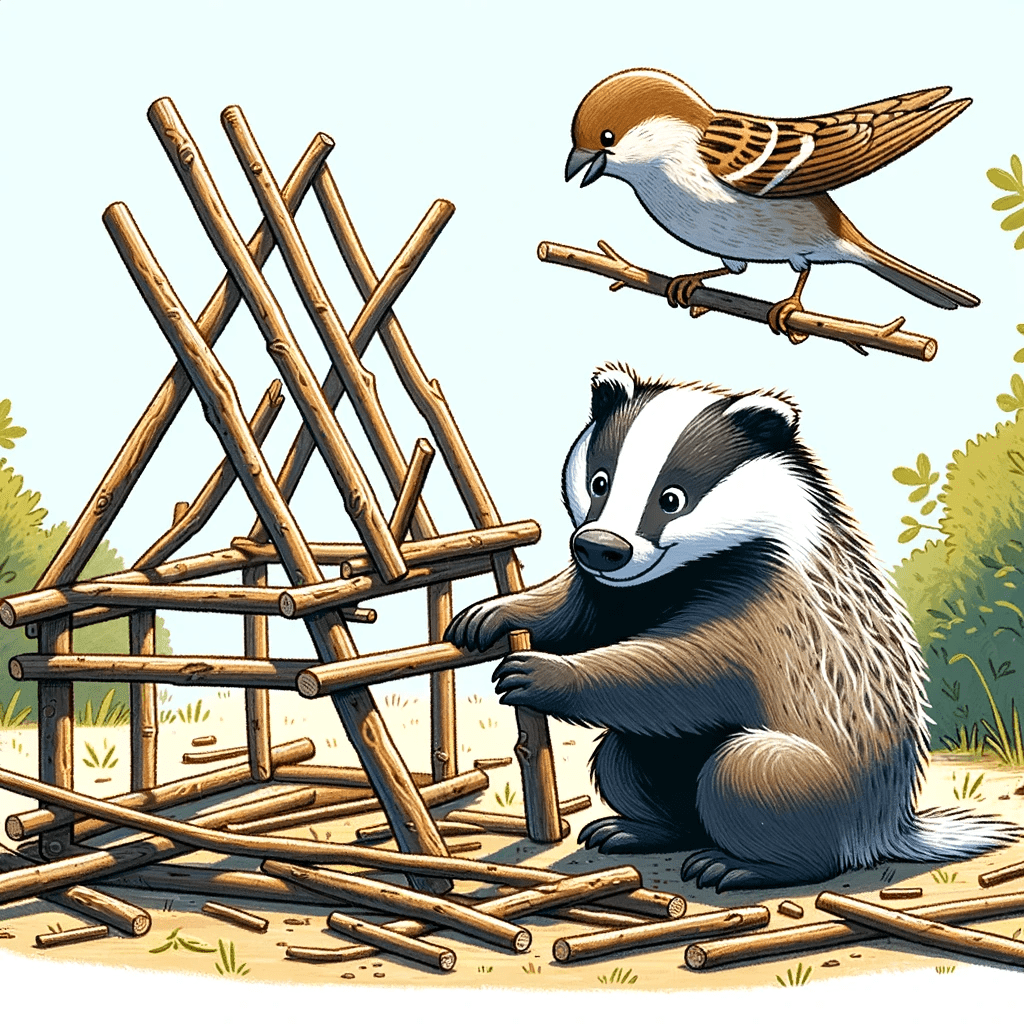
The Badger and the Sparrow

Once upon a time, a Badger and a Sparrow agreed to build a house together. It was not the largest or the most beautiful house that would ever be built, but to them it was special, because it was theirs.

The Sparrow provided all of the wood pieces. She was much more mobile than the Badger, so it was easy for her to fly to all different parts of the forest and bring back small little pieces of wood to build the house with.

The Badger put together the wood pieces, patted them with his tail, and made sure that they stuck together.

In this way, they constructed the house that was special to them. They put up the walls, and made a place for a door. They put in windows with a view of the nearby river, and the Sparrow even found little squares of glass for them.

Then one day it was time to finally put on the roof. The Badger worked furiously on the plans, and waited for the Sparrow to show up, so that she could collect the wood.

The Badger waited for a long time, and still the Sparrow did not appear. So, he went back to working on the plans for the roof, and made them even better. He figured out how it could use less wood and yet still have a few new ornaments. He figured out how the roof could slope just in the right way for the rain to slide off down a chute and and into the nearby river. He worked for many hours, fixing up little parts of the plan here and there.

But still the Sparrow did not appear.

After even more hours of waiting, the Badger became worried, and he decided that he had to go off into the forest to search for the Sparrow. He traveled the trails, and looked up in the trees. He went into the caves, and he swam in the river. He watched the sky in all directions. Yet still, he could not find the Sparrow.

There was nothing for the Badger to do but go back to the house and wait for the Sparrow to appear. He paced the ground, and watched the sky. Even when he went to bed that night, he did not sleep, in case the Sparrow came back.

Early the next morning, the Sparrow finally appeared! She came rushing into the unfinished house, and said, “Oh, dear Badger, I am so sorry! I have been gone, but now I have returned. Let me go get some more wood for you!”

The Badger stopped her gently, and said, “Where have you been, Sparrow?”

The Sparrow mumbled, “I have been building another house.”

The Badger was quite surprised! He asked, “Another house? Where is it? Are you building it by yourself?”

The Sparrow shyly said in reply, “Yes, another house. It’s just across the river, and the plans that we have for it are very beautiful. I am building it with a wonderful Duck. We have only started to build it, but it is going to be quite a house when it is done!”

The Badger said, “What about our house? I have some very exciting plans here, for the roof!” He pulled out the plans, of which he was very proud, and showed them to the Sparrow.

The Sparrow looked down at the plans, and smiled a little. “Yes, those are very nice plans,” she said, “I would like to help you build it.”

And so the Badger was pleased, and the Sparrow’s disappearance forgotten. The Sparrow found many sticks out of which the badger could build the roof. The house had gotten wet while she had been gone (because there was no roof), so she also had to get a few sticks to replace some rotting wood with. However, she managed to get enough sticks in just a few days to replace all the rotting wood and even build half the roof.

The Badger and the Sparrow both were happy, and everything was going well. Once again, they were building the house that was special to them.

One evening, while the Badger was sleeping, the Sparrow was walking around outside the house, enjoying the stars before she went to sleep for the night. A Rabbit walked by, and saw the Sparrow. All of a sudden, a great idea came to the Rabbit’s mind. You see, the Rabbit had some very pretty plans for a very unusual house, but nobody to help him fetch sticks. He saw this Sparrow, and he knew, “This Sparrow and I can build a house together!”

The Rabbit walked up to the Sparrow, and said, “Sparrow! You have wonderful wings on which to fly, and your beak, though it is small, can carry many sticks. I have some plans for a house, but sadly, nobody to build it with. If you would build my house with me, my whole life would be happy.”

How could the Sparrow resist such a request from such a kind Rabbit? That very night, she flew out to get sticks for the Rabbit. She spent most of the night flying around and searching out the very best sticks for the Rabbit’s very interesting house. She was happy, because she was able to help the Rabbit so much.

The Sparrow spent all night and all day helping the Rabbit with his house. She slept for only a little while, and then spent even another day after that bringing sticks to a pile, so the Rabbit could form them into walls.

The Rabbit and the Sparrow worked for three days and three nights, and they built many nice walls. But then the Sparrow remembered, “Oh! I have a house to build with the Badger!” So she flew in a great hurry back to the site of the house that was special to her and the Badger.

When she arrived, she found out that their house had gotten wet, once more. The half of the roof was still there, but some of the wood in the walls was getting rotten, and would need a little bit of work to be replaced.

The Badger was unhappy. He had not known where the Sparrow had went, and he had been worried. He gently asked, “Where have you been, Sparrow?”

The Sparrow mumbled, “I have been building another house.”

The Badger was a little surprised. He asked, “Another house? Where is it? Are you building it by yourself?”

The Sparrow shyly said in reply, “Yes, another house. It’s just down the river, over the hill, and the plans that we have for it are very interesting! I am building it with a Rabbit. We have only started to build it, but it is going to be quite a house when it is done!”

This time, the Badger realized that the Sparrow was never going to stay around long enough to actually finish the rest of the house. And she did seem so very interested in building other houses. So he said, “That sounds wonderful. I hope that you enjoy building the house with the Rabbit! I think that we’re not going to finish building our house, now, but that’s OK. I had a great time working on the house with you.”

The Sparrow agreed. “Yes, I think I’m going to go work on this very interesting house with the Rabbit. He needs my help ever so much! And it really is a very interesting house.”

The Badger smiled, and nodded, and waved as the Sparrow flew away.

For a while, the Badger waited in the house, in case the Sparrow returned. The house was so well-built that not all of the wood could ever rot, and there were some wonderful rooms that he could sleep in. He looked out the window, at the river rushing by. He walked through the empty doorway, and leaned against the wall built of the sticks that the Sparrow had gathered.

After some time, the Badger smiled, and left the house, heading into the woods. Perhaps another day this house would be complete, but today it was time to build another house, in another place.

To this day, a little house sits by the river, built by a Badger and a Sparrow. It has a little glass window, and a place for a door. It was special to them, and no matter how wet it gets, it never rots all the way through.

-Max

The Goddess of the Three Forests

The Goddess of the Three Forests looked down on her people, and she was happy. For she was loved by her people, and she loved them in return. Indeed, how could it be any other way? For to look at the face of the Goddess was to know love, and to see her people was to know joy.

Every forest labored in the love of their Goddess, that they might grow warmer in her favor and live closer to her light.

In the Forest of the Wise, they watched all the events of the world, and wrote them down in books to give knowledge to their children and their Goddess.

In the Forest of the Strong, they trained their children to chop wood and protect each other, so that all of them would have homes, and the land of their Goddess would be safe from any who wished them harm.

In the Forest of the True, they sang songs of joy and told all people about the wonders of the Goddess, so that the Forests could have music and others could know their happiness.

There was no happier world than this, and no happier Goddess in it.

She shared her smiles equally with all of the Three Forests, to let them know of her happiness.

One day, she was walking the Forest of the Wise in human form, and she came across a Wise Man. She saw that he was reading a book, and she said, “May I read your book?”

The Wise Man looked up, saw a beautiful woman, and said, “Of course you may! Knowledge is for all, and is to be shared equally.” The Goddess read a few pages of the book, and laughed because she was happy.

Upon hearing her laugh, the Wise Man realized that this was the Goddess! He rushed back to his town to get the other people of the Forest of the Wise, and he brought them back with him. They all came to where the Goddess was, and presented her with many books. She laughed at all of them, even if they were very serious.

Some of the Wise Men frowned when she laughed at their serious books, though. They said, “But those are serious, do not laugh!”

In response, the Goddess giggled in a very high voice, and smiled at the serious Wise Men, who frowned at her a little more. So she laughed and laughed and laughed, until she realized that the serious Wise Men were now very unhappy.

When she realized that she had upset them, she became unhappy, too! So she disappeared back into the sky, and did not walk in the Forest of the Wise anymore.

However, she was not unhappy for long, and another day found her skipping in the Forest of the Strong, where she came across a Strong Man chopping wood. She said to him, “May I borrow your axe?”

The Strong Man looked up, saw a beautiful woman, and said, “Of course you may! All should grow strong, that they may build homes and protect the forests!” He handed her the axe, and she gave him a hug in thanks.

The Strong Man was completely smitten with the beautiful woman as soon as she touched him, for such was the power of the Goddess. And when she felled a dead tree in one blow, he realized who she was! He said (though he knew it was silly), “Goddess, will you come live with me in my home of wood that I have made myself?”

She laughed in reply, and skipped away toward his town. He ran after her, desiring always to be near his Goddess and love!

When they reached the town, many people saw the Strong Man chasing after a beautiful woman, and they laughed. “How weak he looks,” they said, “chasing like a dog always after her!” The Goddess laughed with them because she loved her people, and when they joked it was funny.

But the Strong Man did not laugh. He was hurt. And when the Goddess skipped by his house, he realized that she was not going to live with him, but was only skipping into the town to see her people.

The Goddess saw this, and turned to the Strong Man and said, “Don’t worry. It will be okay.” But deep in her heart, she knew that she had accidentally hurt the Strong Man. So, she disappeared and tried to avoid skipping in the Forest of the Strong from then on.

Now, she did not know what to do about the Strong Man, but she could not go to the Forest of the Wise and get knowledge, because she had upset some of the Wise Men. So, her only choice was to wander in the Forest of the True in search of something to help her.

And in time, indeed she found a True Man playing his flute, sitting against an old oak tree. She said to him, “Could you play me a song?”

The True Man only smiled and began to play, for they rarely needed words in the Forest of the True. He played her a song of Wisdom, a song of Strength, and a song of Truth. She felt herself uplifted by the melody, and smiled at him with all the warmth that a Goddess can show.

The True Man smiled in return. He had known that this was the Goddess from the moment she appeared; the smile only confirmed his knowledge.

They sat for a long time while he played the flute and she smiled. The sun set, and rose, and set, and rose again while the melody never stopped. The True Man had found his purpose, and the Goddess was happy with what she had found in the Forest of the True.

They walked together for many weeks, sometimes in the forest, and sometimes in the town. There were few people in the Forest of the Truth, but all who saw her knew her as the Goddess, and were happy for the True Man who walked with her. He played the flute, and sometimes she would sing through her smile, a glorious sound.

After the sun had risen many more times, the True Man finally found his words. He turned to the Goddess and said, “I love you, Goddess, and would know if you feel the same.”

She giggled, and said, “But of course! I love you just as I love all my people!”

But the True Man had meant something more, and was devastated at these words. He fled into the forest speaking words to himself for a time, for he no longer trusted that his melodies would bring truth to him.

And now the Goddess had nowhere to go, for in all her good intentions she had upset the Wise Men, hurt a Strong Man, and fooled a True Man. So, she disappeared into her palace in the sky, and tried to smile at all her people from there.

How do I know all of this? Well, dear reader, I was there. And I hear rumors that sometimes she comes out of the palace even now, but disguised in many ways.

So, keep an eye out. You never know when you might see her, skipping through your Forest, laughing and smiling and wanting everybody to be happy.

-Max

The Schoolchildren and the Bully

Once upon a time there was a class of happy schoolchildren. These schoolchildren generally got along pretty well. They were happy to go to school, they learned a lot, and they played many interesting games on the playground.

Their favorite game to play on the playground was dodgeball. When they played dodgeball, they divided themselves into two teams, called the Gnomes and the Ogres. The Gnomes and the Ogres were basically the same, except that the Gnomes had decided that the best strategy was to increase team morale by passing ball around evenly (so everybody got a shot), and the Ogres had decided that the best strategy was to scare the other team by throwing the ball really hard. So the Gnomes would pass, and the Ogres would throw wildly. They had many interesting and enjoyable games against each other, and all was well on the playground.

One day, a Bully came along, picked up the ball, and gave a black eye to one Gnome, and a black eye to one Ogre. He then ran away and hid himself in a place where none of the schoolchildren could find him.

All of the schoolchildren were very upset. The Bully had been very mean to them, and they were afraid he would come back and be mean again. They had to decide what to do about the Bully!

The Ogres said, “First, we need to protect our playground!” The Ogres declared that all Bullies who entered the playground would immediately be given black eyes! The only problem was that they couldn’t tell who was a Nice Person, and who was a Bully. So, they made up a test to give to all the people who came on the playground, to figure out if they were Bullies or not. It gave them less play time, but they all felt safer.

The Ogres said, “Now, we need to hunt him down and make sure that he doesn’t do that again! We need to give *him* a black eye!” The Gnomes, being basically the same, agreed, and said “OK, just make sure that everybody gets a chance to do it.”

Maybe some of the schoolchildren disagreed, but they didn’t want to upset anybody or get in trouble by arguing. They all took the playground-entry test quietly, and then went and had fun playing dodgeball on the playground. They also helped the Ogres look for the Bully. After all, they didn’t feel safe with a Bully running around!

The first place that they looked for the Bully was in an old, abandoned playground. They met some quiet children there, and the Gnomes said to them, “Do you know where the Bully is? We’d really like it if you’d tell us.” The quiet children knew where the Bully was, but once upon a time the Bully had protected them from other Bullies, so they wanted to protect the Bully. The quiet children said, “No, we don’t have any idea where the Bully is.”

The Ogres were very mad. They said, “Give those quiet children a black eye!” They threw dodgeballs at the quiet children very hard, and gave them black eyes. Eventually, all the quiet children ran away. The Ogres said, “Good! Now we feel safe, because there are no friends of the Bully anymore on this old, abandoned playground.” All the schoolchildren nodded their heads and went back to their playground.

Then, the Ogres decided that to look for more quiet children, because maybe other quiet children would also know about the Bully. They searched out another old playground, and they found some older quiet children there.

The Gnomes tried to talk to the older quiet children for a long time. They said, “Where is the Bully?” The older quiet children didn’t know, so they said, “We don’t know.” Then the Gnomes asked again, and the older quiet children said, “Go away, we don’t know anything about the Bully. And anyway, you annoy us. We wouldn’t tell you even if we did know.”

The Ogres saw a small box next to one of the older children’s feet. They said, “You’re hiding the Bully’s dodgeball in there!” (Some of the Gnomes muttered, “But… the Bully used our dodgeball…”) The older children said, “Go away. You’re annoying us. Go back and play on your playground.” This made the Ogres so mad that they shouted, “Give those older children a black eye!” They threw dodgeballs very hard at the older children, and gave them many black eyes. It was mean, but they all felt safer because they had protected themselves against the older children, who might have had a Bully’s dodgeball.

Afterward, the Gnomes walked up to the box, and they opened it. They found that it was one of the older children’s lunch. It had some good cookies in it, so they all shared it between themselves. They were safe, and they were happy because they had eaten some good cookies.

All the schoolchildren went back to the playground, and they started to play a game of dodgeball. Of course, it took them a while to all take the test to get onto the playground, and they were all very worried that the Bully might come back.

While they were playing, the Ogres realized something. They said, “Gnomes! We must protect you! You do too much sharing, and not enough throwing! If the Bully comes back, you won’t be able to give him a black eye fast enough!” So, they changed the way that they played dodgeball, so that the Ogres were always in a big circle outside, and the Gnomes were in a small circle inside.

They never did catch the Bully. But they did find some more quiet children and give them black eyes, from time to time. And the Ogres always won at dodgeball from then on, because of the changes on the playground.

But it was OK, because everybody felt safer.

-Max

A Passing Piece of Fiction

Once upon a time there was a beautiful winged fairy who had lived many lives. Whenever she would pass away, she would return again in a brilliant burst of light somewhere else, with no memory of who she had been before. However, in between each death and rebirth, she got to choose where she would end up next.

This fairy dedicated all her lives to helping those in need. Whether it was a desperate leader of a dying country, or simply a confused student trying to get through life, the fairy always did her best to help them.

And for many, many lives, she succeeded. Despite the fact that she would grow old and die (or pass on by other accidental means), she could leave the world with the knowledge that she had helped others and they knew it.

One day in a cold November, however, something different began.

At first, everything was normal. The fairy passed on once more (as she had many times before), and had to choose a new place to go. She searched far and wide for a human in need of her services. She saw hungry children in poor countries. She saw death and destruction, war, famine, disease, and all the mental and physical ills of mankind. But all of these were beyond her control. For though she had many magical powers, they were not great enough in power to turn around the entire direction of the world with a single wave of her wand. Instead, her way was to pick the small battles, and help win enough of them to eventually turn the tide.

So, this time she picked a married Couple who lived in a small cottage outside of a big city. They had been happy for a long time, but recently they had started to have problems.

You see, the Lady was a very talented painter, and the Man was good at business. They had made a modest living together selling her paintings, and in that they were happy.

But the Lady yet held some scorn and unhappiness toward life and the Man, and the Man held some indifference and boredom toward life and the Lady.

The fairy saw this, and her little heart cried out. She knew that she could make a difference in the lives of these worthy people, that with her determination and magic, she could change their lives.

On the spot, she chose to come back to life and live with this couple.

When the fairy appeared, the Lady found her quite wondrous. Merely by the fairy’s showing up, the Lady’s frowns became smiles. The Man saw the fairy, and he too found excitement in life once more. For here was magic, and where there is magic no life can be dull or scorned.

The fairy, of course, immediately forgot everything as she came back to life and looked upon the Man and the Lady. However, she remembered her desire to help, and she too came to smile when she saw her effect upon the Couple.

And so it was good, for quite a time. The Lady’s wonder at the fairy caused her to forget her scorn of life, and the Man’s delight at the magic made him pay attention once more to his Lady. But more important than all to them was the fairy herself, for it was the fairy that had caused their rebirth.

Great, however, was the cost to the fairy. For in removing these things from the Couple, her magic demanded that she take their woes upon herself.

And though they were simple people, their woes were many. It was this world and they themselves that were the source of their woes. Many are the glories of humans, but many also are their follies. Instead of targeting their follies with her magic, the fairy had merely changed their feelings.

In time, the fairy began to sicken. Her wings no longer worked correctly, and she became dependent upon care and nurturing from the Lady. Meanwhile, the Man became ill at ease, since he had not desired to spend his life tending sick fairies. He became more distant from the fairy, though he still smiled whenever he looked upon her. He knew in his heart that the fairy was the greatest thing he had.

As the fairy became sicker, her magic started to weaken. The scorn of the Lady returned slowly, and with everything added up, the Man and the Lady could no longer live in the same cottage with each other. The Man built himself a cottage next door and stayed in it by himself, though he was still very friendly with the Lady and the fairy.

The fairy, of course, had to stay with the Lady, since the fairy was dependent upon the Lady’s care. And they both found this arrangement equitable, since they did quite like each other. And after all, what remained of the fairy’s magic was all that kept light in the Lady’s life.

Now, this was not only a world of fairies, but also a world of Shadows. And soon after these events, a Shadow snuck into the house of the Lady, slipping through the door when the fairy was sleeping from her illness.

The Shadow meant only to hurt the Lady, and to destroy the fairy. Of course, it takes more than just a simple Shadow to truly destroy even a sick fairy. So despite all the Shadow’s attempts, the fairy still shined her light, flapped her wings, and worked her magic.

In time, the fairy drove the Shadow from their cottage, but not without cost to both her and the Lady. The Lady had lost much — she could no longer paint, and her life had become as dark and foul as before the fairy had appeared. The fairy waved her wand, but it was in vain. The force of Life and the evil of the Shadow had overcome all she could do.

So, as was her nature, she decided that it was time to go somewhere where she could be of help. And of course, the closest place was next door, in the cottage of the Man.

In the cottage of the Man, she gained strength once more. She brought some mild happiness back into his life, and that pleased the fairy.

And with her successes, she gained enough confidence to go out into the world once in a while. She traveled to the city, and to the libraries there where she could learn more and more about how to help the Man, the Lady, and maybe even some other humans.

At the libraries, she met many fascinating people. Some of them tried to steal her magic. Some of them tried to harm her so that they could stop the happiness she spread. But most of them were very nice, as people are.

One, however, was fascinating above all. He was a Writer, come to one library so that he too could learn how to help others. The most fascinating thing about the Writer was that he did not need the fairy’s help. He wrote well, his life was pleasant, and his goals were always achieved.

In time, the fairy and the Writer became good friends. The Writer was inspired by the beauty and simplicity of the fairy, and the fairy was awed by the will and simplicity of the Writer. Together, they had many adventures that cannot all be written here, except only to say that each was unique and incredible in its own way.

With the help of the Writer, the fairy began to glow more brightly than she ever had, and her magic returned in full force. The Man and the Writer met, and they were pleased with each other’s company, though never fast friends. Also, the fairy had re-gained enough power to once again visit the Lady and help her smile.

Once again, all was glorious.

But the scorn of the Lady remained, deep inside. Neither the power of the Writer nor the power of the fairy was great enough to change the Lady fundamentally. And indeed, the Writer and the fairy did not want to change the basic nature of the Lady — she was who she was, and that was her greatest right. If that included scorn, then so be it.

And there was one other problem, hidden within it all. Though the fairy glowed beautifully, flapped her wings wonderfully, and waved her wand with ease, she was still sick. There was nothing the Writer could do to make her truly recover, and neither the Lady nor the Man had kept any interest in seeing the fairy well again. For after all, the fairy’s sickness had allowed the Lady to become more powerful than the fairy, and the Man was simply as indifferent as he always had been.

When the Lady saw how powerful the fairy had become in her friendship with the Writer, she became jealous. She told the fairy to stop adventuring with the Writer.

Of course, the fairy ignored the Lady’s advice, and kept on her adventures with the Writer. But the Lady’s words were still confusing, even if ignored, and it complicated the fairy’s otherwise simple existence. She desired to know the Writer, but she also desired to help the Lady. It was a conflict that seemed to have no resolution.

But one resolution did appear to the fairy. One day, on her adventures with the Writer, when she separated from him briefly to explore a forest, she met a Poet. The Poet spoke in beautiful words of many lands far away, and the fairy could hear in his words the goodness in this Poet.

Despite his inner beauty, the Poet was imperfect in many ways. He could not sleep easily, and he had only crude companions to pass his days with. The fairy’s heart nearly leaped out of her small body when she realized how much she could help this poor Poet. Also, what remained of the fairy’s old sickness was enough to cloud her judgment just a little. So, confused and feeling the Poet’s need, she decided to leave the Writer behind, and disappear with the Poet into the woods. Anyway (she thought) the Writer could fend for himself, and this Poet was having a very hard time.

By leaving the Writer behind, she solved her problem with the Lady. The Lady met the Poet and approved of him greatly. All seemed well.

But what about the Writer? He was hurt that the fairy had left him alone on their adventure. At first he was angry, but eventually he consigned himself to understanding the difficulty of the fairy’s situation, and decided that it was best to leave her alone. After all, no matter how hard he tried, he could never change the fairy’s need to help others, nor could he truly repair her sickness.

So really, in the fairy’s sickness-clouded sight, this seemed like a Happily Ever After, and all had gone well. She had resolved her problems, the Lady approved of her again, the Man was well, and the Poet improved. The Writer was invincible anyhow, and no real harm could be done to him. They had ended their association, but they had some fine memories to take with them.

But what truly happened? The fairy had failed to help the Lady and had betrayed the Writer. The Man was still indifferent (though happy to see the fairy, always). The Poet drank in the fairy’s light, and was bound on the exact same road as the Lady and the Man — his feelings changed, but his life the same.

The end of the story was not written, and who knows what the fairy will see upon her passing on and rebirth in her future lives, or even in the simple future of the story told here. How will she leave this life? What will she think?

There is only one thing that I can tell you — there are infinite possibilities when magic is involved, and each branch of fate can be more glorious than the last in the brilliant glow of a fairy’s light.

Are there any villains in this story? No. And there are many heroes. But I suppose that no matter the number of heroes, and no matter how great the intentions, not all fairy tales may be as sweet as others.

Some might say it was a Realistically Ever After. To them, I’d say that there is not enough real magic in their lives, and they haven’t known enough fairies.

-Max

A Secret

I’m going to tell you a secret. 🙂

Once upon a time, there was a little person.

This little person had an endless supply of love for every other person in the world, no matter who they were, what they looked like, the clothes they wore, how they talked, or anything else.

But everybody else in the world did not have an endless supply of love for this little person. Sometimes they were indifferent, offended, mean, or just apathetic. Once upon a time they, too, had had an endless supply of love for everybody, but others had been indifferent, offended, mean, or just plain apathetic. And eventually they became just like the people who had rejected their love.

And so this, of course, eventually happened to the little person. The little person found ways to hide their love, to express it only where others couldn’t see it, or to mask it behind indifference, offense, cruelty, or just plain apathy.

But one day, the little person found a way to express their endless love in a way that nobody could touch, that was invincible and immortal.

And once again, the little person remembered what it meant to be human.

-Max